Title
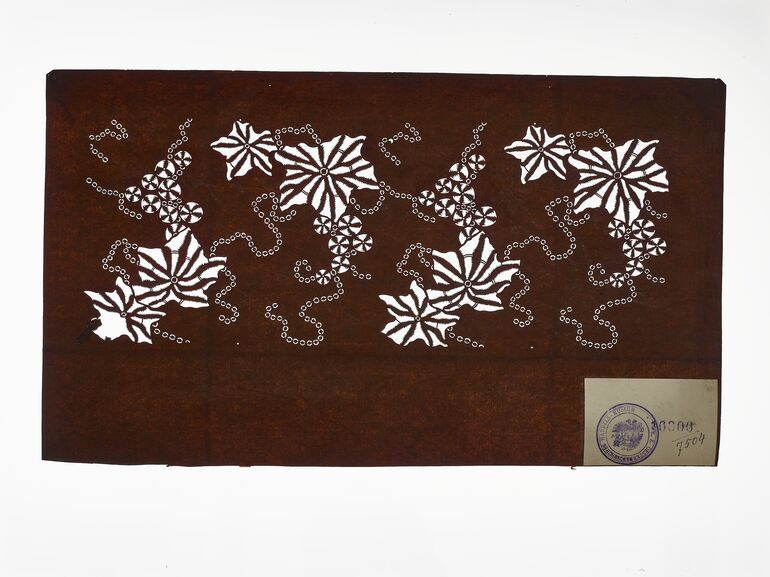
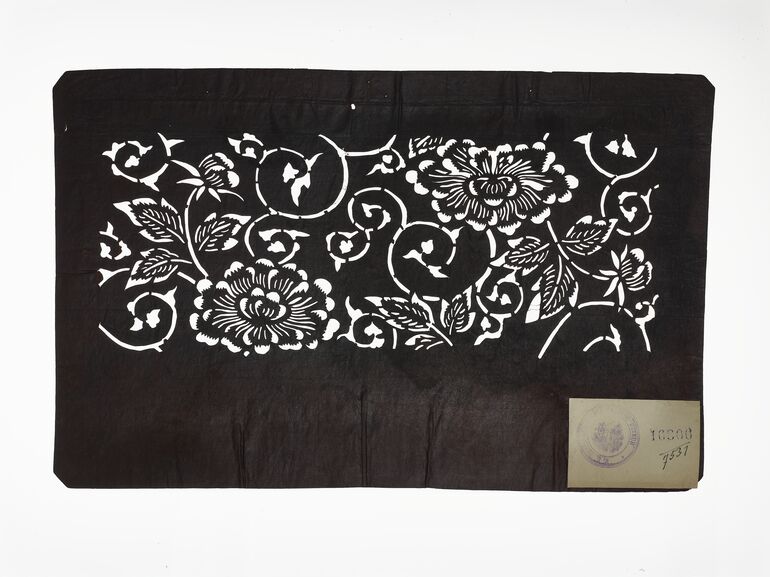
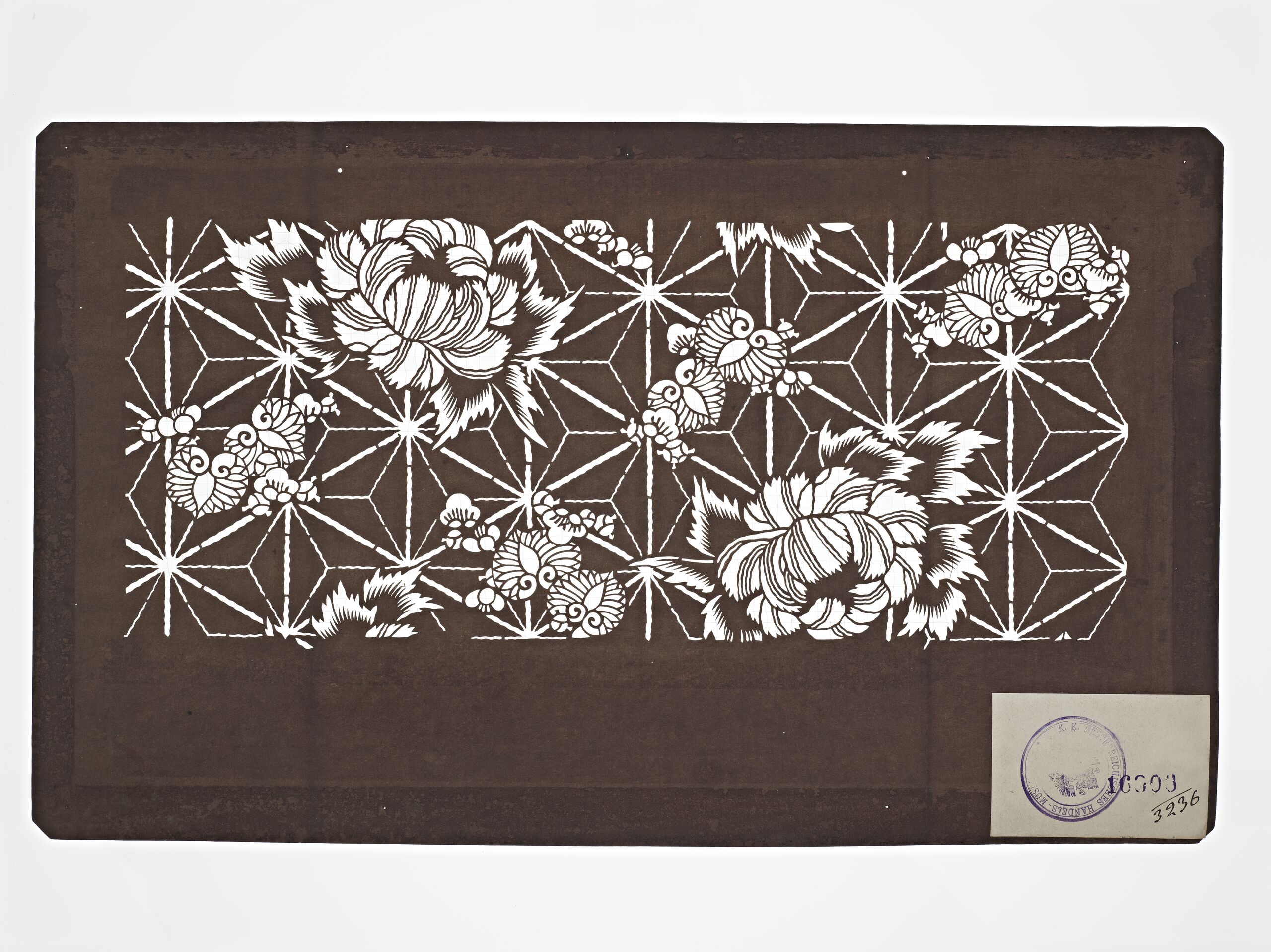
- Surface pattern (waritsuke monyō 割付文様), plant pattern (shokubutsu monyō 植物文様): peonies, wild ginger leaves and plum blossoms on asa no ha 麻の葉 (hemp leaf)
Collection
Production
- execution: anonymous, Mie, 19th century
- retailer: Shimajin 嶋甚
Period | Style | School
Material | Technique
Measurements
- height: 25.5 cm
- width: 42.1 cm
- 1 Muster - height: 14.8 cm
- 1 Muster - width: 35.5 cm
Inventory number
- OR 3925-3236
Acquisition
- assumption , 1907
Department
- Asia Collection
Inscriptions
- stamp: Dealer (型売商人 katauri shōnin): [嶋屋甚兵衛 Shimaya Jinbee]Shop Name (暖簾名 noren na): 嶋甚 ShimajinTrader’s Logo (yagō 屋号): 曲尺に甚 kanejaku with "JIN"Location (所在地 shozaichi): 勢州白子新町 Seishū, Shiroko Shinmachi 萬小紋形仕入 man komongata shiire (Komon procurement)Black stamp, rectangular with rounded corners (角丸長方形 、黒印 kadomaru chōhōkei, kokuin)
Description
-
"Dyed ground" (jizomari 地染), "main stencil" (omogata 主型).
The wild ginger (aoi 葵) belongs to the Aristolochiaceae family. The mostly heart-shaped leaves are arranged opposite each other on the stem. This plant is said to unite gods and humans and is therefore considered auspicious. It is also the coat of arms of the Kamo Shrine in Ōmihachiman (近江八幡市) in Shiga Prefecture. The coat of arms of the Tokugawa clan, featuring three wild ginger leaves in a circle, is well known and is often referred to as the "mallow crest," as wild ginger originally belonged to the mallow family in Japan.
Peonies symbolise wealth and beauty. Because of their magnificent blossom with many petals, they are often used as a motif for handicrafts. Red peonies were even said to be able ensure longevity and immortality when drunk as an herbal decoction.
The blossom of the plum (BAI/ume 梅) is a symbol of the beginning of spring, as it begins to bloom in the cold season. The plum blossom pattern is auspicious and represents longevity, endurance and prosperity of the descendants.
Asa no ha 麻の葉 (hemp leaves): a hexagonal pattern called asa no ha 麻の葉 because it resembles the hemp leaves. A hemp plant is robust and grows straight up. Therefore, the pattern is said to have been preferred for the clothes of the newborns. It is not only found on kimonos, but also on obi, under kimonos and small pouches.
-
stencil (katagami 型紙), Surface pattern (waritsuke monyō 割付文様), plant pattern (shokubutsu monyō 植物文様): peonies, wild ginger leaves and plum blossoms on asa no ha 麻の葉 (hemp leaf), Anonym, MAK Inv.nr. OR 3925-3236
-
https://sammlung.mak.at/en/collect/surface-pattern-waritsuke-monyo-割付文様-plant-pattern-shokubutsu-monyo-植物文様-peonies-wild-ginger-leaves-and-plum-blossoms-on-asa-no-h_317665
Last update
- 03.11.2026
Related via
Artist
Artist
Location
Material